
Why Rest Feels So Uncomfortable — Especially for Women Who Carry Everyone Else
RELATIONSHIPSSELF ESTEEMBOUNDARIESANXIETYRUMINATIONOVERTHINKINGPEOPLE PLEASINGWORRY TIME


You may know you need rest, but when you finally slow down, your mind starts racing. You think about the laundry, the emails, the people who need you, the text you have not answered, or the tasks still sitting unfinished. Instead of feeling peaceful, rest may bring guilt, anxiety, or the uncomfortable sense that you are doing something wrong. For many women, especially those used to being the dependable one, rest does not feel natural at first. It can feel selfish, lazy, or unsettling. However, that discomfort does not mean you are wrong to rest. It may mean your mind and body have learned to associate your worth with being useful, available, and productive.
Why Your Nervous System Resists Rest
Your body was designed to respond to stress. In short bursts, this can help you handle responsibilities, protect others, and get things done. However, when stress becomes constant, your body can stay in a state of tension and alertness for too long. That is why rest may feel uncomfortable at first. Your body may be tired, but your nervous system may still be bracing. You might sit down and feel restless. You might try to relax and suddenly remember ten things you “should” be doing. This is not failure. It is a sign that your system may need practice feeling safe in stillness.
The Burnout Cycle
Burnout is more than being tired. Maslach and colleagues describe burnout as a response to chronic emotional and interpersonal stress, often involving exhaustion, emotional distance, and a reduced sense of effectiveness. For women who carry everyone else, burnout can look like functioning on the outside while feeling drained on the inside. You keep showing up, but you feel resentful, numb, overwhelmed, or disconnected from yourself. The cycle often sounds like this: “I am exhausted, but I cannot stop. If I stop, things will fall apart.”
The CBT Perspective: Notice the Thought
Cognitive behavioral therapy helps people notice how thoughts, emotions, and behaviors influence one another. When rest feels wrong, ask yourself:
What am I telling myself about rest?
Maybe the thought is, “I should be doing more,” or “People will be disappointed if I slow down.”
A more balanced thought might be:
“Rest helps me show up with more steadiness, clarity, and compassion.”
This is not about making excuses. It is about telling yourself the truth with kindness.
Boundaries Make Rest Possible
Rest is hard to protect without boundaries. You may need to practice saying, “I cannot do that today,” “I need time to think,” or “I am not available right now.” A boundary does not mean you do not care. It means you are learning to care without abandoning yourself.
A Faith Reflection for the Weary
If you are leaning into your faith, it may help to remember Jesus’ words in Matthew 11:28: “Come to me, all you who are weary and burdened, and I will give you rest.” That invitation is not only for people who have finished everything. It is for the weary. Biblical rest is not laziness. It is trust. It reminds us that we are not God, and we were never meant to carry everything alone.
Try This Small Rest Practice
Choose one 10-minute rest period this week. Before you begin, write down one guilty thought. Then write one balanced truth.
Example:
Guilty thought: “I should be doing more.”
Balanced truth: “Rest helps me care for myself and others in a healthier way.”
Then rest for 10 minutes without earning it first.
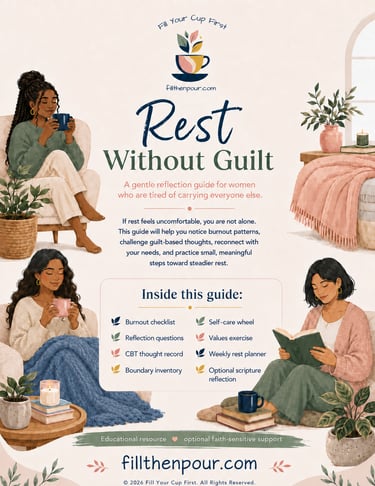
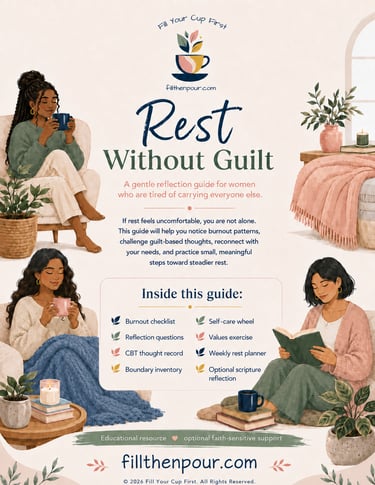
Download the Rest Without Guilt Reflection Guide
For more support, download the Rest Without Guilt Reflection Guide. It includes a burnout checklist, reflection questions, a CBT thought record, a boundary inventory, a self-care wheel, a values exercise, a weekly rest planner, and an optional scripture reflection. You do not have to keep running on empty. Fill your cup first and then pour into others.
Fill Your Cup First
Then pour into others.
Contact
© 2026. All rights reserved.


How to Set Boundaries Without Guilt: 5 Ways to Protect Your Peace is a free guide designed for women who are tired of overthinking, people-pleasing, and feeling emotionally drained.
Enter your email to receive the free guide and occasional emails from Fill Your Cup First. Unsubscribe anytime.